Awareness in spiritual practice – a Vedic Yoga Centre perspective
Awareness in spiritual practice begins with recognising this simple truth — before we learn language, concepts, or intellectual understanding, we already have the ability to see, feel, and experience what is happening around and within us.
A newborn child does not understand language. The child has no knowledge of culture, religion, education, or social identity. The child does not yet know the meaning of mother, father, family, relationships, nor any theories about life or intellectual understanding of the world.
Yet something is already happening – the child sees, hears, feels warmth, cold, hunger, comfort and touch. The child simply recognises what is happening from moment to moment.
This is awareness.
This simple observation supports the idea that awareness in spiritual practice is not something that we have to create. Rather, it is a natural faculty that has been with us from the beginning.
In many ways, the work of yoga is to rediscover it, refine it and learn how to remain connected with it.
Awareness comes before understanding

As a child grows, recognition slowly develops.
The baby gradually recognises the woman who repeatedly comes close, feeds, holds and soothes as the mother. Other faces also become familiar. Sounds begin to have meaning. Relationships, objects and places acquire names. Words form into sentences.
Later comes education.
We learn to read and write, and to understand mathematics, science, history, culture, and social behaviour. We learn to analyse situations, compare one thing with another and reach conclusions. Eventually, the faculty of intellectual understanding starts to strengthen.
While this development is necessary to function in the world, we notice that something subtle has also happened. Because so much importance is given to knowledge and understanding, we begin to depend almost entirely on the thinking mind. We assume that if we can explain something, we know it.
Yet before explanation came awareness; before its name came the experience; and before the concept came direct perception.
This distinction becomes especially important when we enter yoga, meditation and spiritual practice.
The difference between knowing and experiencing
Today we have access to an enormous amount of spiritual information.
We can read about chakras, Kundalini, meditation, pranayama, mantra, philosophy, energy, consciousness and many different systems of yoga. We can listen to teachers from all over the world, and we can watch videos, read books and collect explanations.
All of this can be useful: a teacher needs to give instructions, and a student needs to understand the method. Traditional knowledge is the framework that helps us practise safely and with direction.
But information has a limit. Eventually, we have to practise.
If we continually remain only with explanations, we may know many things about yoga without deeply knowing ourselves. This is where awareness becomes essential.
Suppose you are practising a technique in which the awareness is brought towards the perineum. Immediately the mind may say, “This is Mooladhara.” Then your awareness is drawn towards the navel and the mind says, “This is Manipura Chakra.” You may focus on the heart region and immediately think of Anahata. At the eyebrow centre, the mind may begin recalling everything it has read about the Third Eye.
The information may be correct, but something else has happened. Instead of observing, we have started interpreting. Instead of experiencing what is actually present, we have begun comparing our experience with what we know.
Therefore, during practice, there are moments when we need to put the information aside and simply observe.
Learning to observe without immediately naming
One of the simplest instructions in spiritual practice can also be one of the most difficult:
Be aware of what is happening:
- Not what should happen.
- Not what somebody told you would happen.
- Not what happened to another practitioner.
- What is happening within you now?
You could bring your awareness to the navel and feel warmth. Perhaps you feel movement … maybe some tension … or perhaps there is nothing obvious at all.
Stay with the experience:
- If you feel heat, notice the heat.
- If there is tension, observe the tension.
- If you feel nothing, be aware that you feel nothing.
This is very different from trying to create an experience.
Sometimes students become concerned because they have read descriptions of meditation or subtle experiences and their own practice does not match those descriptions. Then expectation enters the practice.
We begin looking for particular sensations. We may even convince ourselves that we are experiencing something because we believe we are supposed to experience it.
Awareness does not need this. It asks only that we see what is there.
Awareness in the Himalayan tradition
Within the Himalayan tradition, yoga is not approached simply as a collection of physical techniques. The practices present different ways to direct our attention inward so we gradually become more conscious of our body, breath, energy, thoughts, emotions, and deeper nature.
This is why awareness is one of the primary aspects of practice at the Vedic Yoga Centre in Rishikesh. Whether a student is practising Hatha Yoga, pranayama, Kundalini kriya, mantra or Vedic dhyana, there is an underlying question:
Can you become aware of what is actually happening within you?
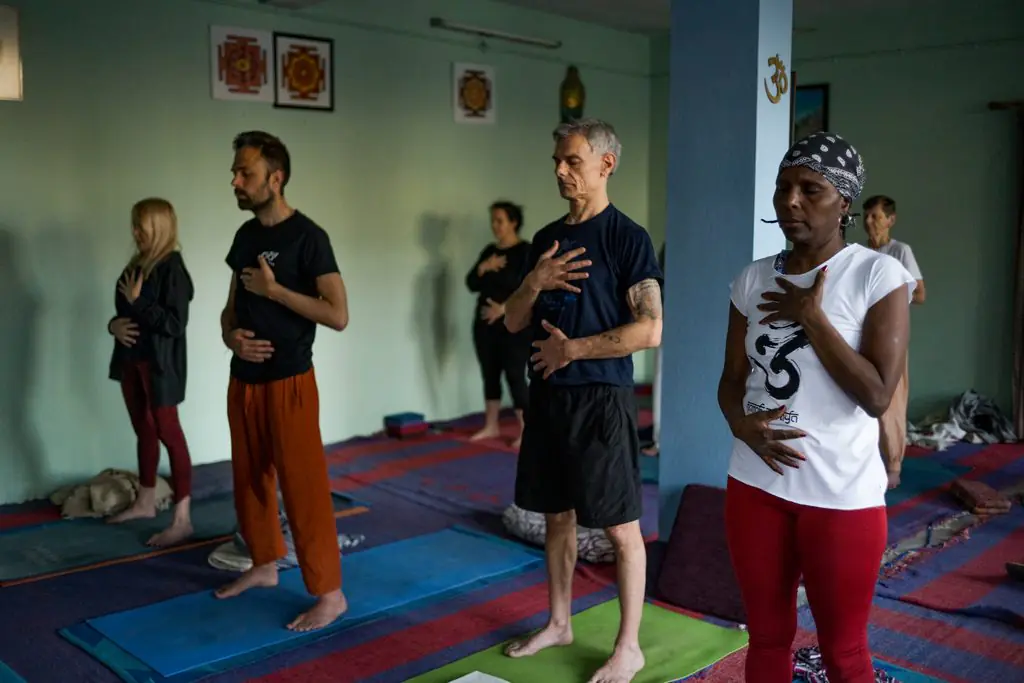
In Hatha Yoga, for example, the aim is not simply to place the body into an asana. We learn to recognise the body, the breath and our inner response while we are in the posture.
With pranayama, we don’t just count the breath. We develop an increasingly subtle awareness of breathing, energy and the state of the mind.
In Kundalini and Tantric kriya practices, we can systematically direct awareness through different areas and processes within the body. Again, the purpose is not to imagine an experience because we have read about it. We observe directly.
In meditation, we begin to recognise the movements of the mind without becoming attached to each thought.
And through mantra, sound itself becomes the means of gathering our scattered attention and bringing us back into the present.
This reflects the approach of Vedic Yoga Centre. The ancient Himalayan teachings are offered not simply as philosophy to be studied, but as a way to develop conscious living.
Taking lessons from the mat into daily life
Over time, the teachings from your yoga classes become a part of your every day life:
- Can we recognise what is happening within us before we react?
- Can we become aware of fear without immediately being controlled by it?
- Can we recognise anger before acting on it?
- Can we observe the restless mind rather than just believing everything it tells us?
In this sense, awareness is not one isolated technique within yoga. It is the thread that connects the different practices.
Awareness needs patience
The modern mind often wants quick results.
We start a meditation technique and immediately want to know whether it is working. After practising pranayama for a short time, we expect a noticeable change. We hear about an inner state and then begin looking for evidence that we have reached it.
Traditional practice does not work well with this kind of impatience. A seed does not become a tree because we keep digging it up to check whether it is growing. In the same way, inner practice needs regularity, patience and observation.
At first, the mind may feel restless. The body may be uncomfortable. Breathing may feel uneven. Thoughts may continue without interruption. Awareness means noticing these things without immediately deciding that our practice is bad.
With time, something will begin to change.
Perhaps the breath becomes quieter. Perhaps we become aware of tension in the body we had never previously noticed. We may begin to recognise emotional reactions before they become overwhelming. We may notice how quickly the mind judges, resists, desires or becomes distracted.
These observations are valuable. They do not mean your meditation has failed. They are your awareness becoming clearer.
The mind wants to interpret everything
The thinking mind’s function is to organise our actions and help us understand the world. The problem begins when we cannot step outside its constant commentary.
We decide to sit quietly, but the mind continues talking:
- “This meditation is going well.”
- “I cannot concentrate today.”
- “I felt something unusual.”
- “Maybe this means my energy is changing.”
- “I should be calmer than this.”
None of these thoughts is necessarily important. Yet when we identify with, or get caught up in, every thought, our attention is continuously pulled away from direct experience.
Awareness gives us another possibility:
- A thought comes, and we know there is a thought.
- A feeling arises, and we recognise the feeling.
- Restlessness appears, and we observe restlessness.
- We do not have to fight it.
- Equally, we do not have to follow it.
This is an important part of developing inner steadiness.
Yoga becomes personal through direct experience
There is a great difference between practising because somebody tells us something is beneficial and discovering the value of the practice through our own experience.
At first, the teacher tells us to sit every morning. We follow the instruction because we respect the teaching. Then, after some time, we begin to observe the effect.
We recognise that our mind behaves differently on the days when we practise. We also notice the quality of our breathing and, most importantly, become more aware of our reactions. More space may open up between an event and our response to it.
Now the practice is no longer only the teacher’s instruction. Something has become personal.
This is particularly important in the Himalayan tradition’s approach.
The teacher can provide the method, knowledge and guidance received through the lineage to preserve the wisdom and practices passed down through the ages. However, the student still has to practise and experience them.
At Vedic Yoga Centre, this is a fundamental component of both our Yoga Teacher Training Courses and our Yoga and Meditation Retreats. Students are encouraged initially to understand the practices, but eventually to experience what happens when those practices are repeated consistently within a disciplined daily routine.
Eventually, knowledge becomes their lived experience.
This personal connection is important because discipline based only on the teacher’s instruction cannot be sustained. When we directly recognise the effect of practice, we no longer practise merely because we think we should.
We practise because we now value it through our own experience. That connection becomes the source of your strength. And from that strength comes inspiration.
Awareness must continue beyond the yoga mat


It is easy to think of awareness as something belonging only to your yoga practice.
We practice our daily routine, observe the breath for twenty minutes and then return to ordinary life. But the deeper purpose of yoga is not to create a spiritual life separate from our daily life.
By introducing awareness on the yoga mat, students begin to learn how to apply this in their everyday life:
- Can we notice the way we speak when we are irritated?
- Can we recognise when we react out of habit rather than respond with clarity?
- Can we feel when the body is becoming exhausted before we force it further?
- Can we observe the effect of our food, conversations, environment and activities on our state of mind?
- Can we recognise when the mind is repeatedly returning to the same fear or worry?
These are simple examples, but this is where the Himalayan approach to conscious living becomes very practical.
Awareness creates the possibility of choice – without it, habits take over automatically.
Bringing awareness into each moment creates space to see what is happening before reacting. Within that space, a different response becomes possible.
Do not turn awareness into another struggle
We also have to be careful not to turn awareness into another source of tension.
The mind can easily do this:
- “I must be aware all the time.”
- “I should not have these thoughts.”
- “I lost my awareness today.”
We are human. Attention moves. The mind becomes distracted. Emotions influence us. Old habits return. Simply recognising that awareness has been lost is the first step of awareness.
There is no need for punishment. Come back. Again and again, come back to what is happening now.
This is how to strengthen the faculty of awareness.
Knowledge should support experience, not replace it
None of this means spiritual knowledge is unimportant
Traditionally, spiritual knowledge was preserved because teachers transmitted it carefully from generation to generation. Study gives direction and helps prevent practice from becoming vague or purely imaginary.
However, you need to find balance between knowledge and experience.
First, understand the instruction – then practise it, and continue practising under the guidance of your teacher. During the practice, give yourself space to observe – what is happening within me? Afterwards, reflection and study can help you understand the experience even more clearly.
The problem arises when we accumulate so much information that we no longer know how to simply sit and observe, or even want to do so. We may know the Sanskrit names. We may know the philosophy. We may be able to explain the techniques, but:
- Can we remain quietly present with our own breath?
- Can we observe what is actually happening within the body?
- Can we notice the mind’s movement without immediately getting caught up in its story?
These simple questions bring us back to the foundation.
Bringing awareness to the Source
At Vedic Yoga Centre, we adopt the traditional approach to yoga: turning our awareness within.
Different practices give us alternative options:
- Asana works through the body.
- Pranayama works through the breath and prana.
- Kriya works with the subtler dimensions of our being.
- Mantra uses sound and vibration.
- Meditation develops concentration and inner stillness.
Yet the purpose is not simply to become skilled in a growing number of techniques.
All these techniques are simply instruments. Through them, we gradually learn to direct awareness away from constant external distraction and towards our inner experience.
This is one reason we have identified for the Himalayan tradition’s ongoing relevance today.
Modern life continually pulls the attention outward. Our senses are stimulated, information is constant, and the mind rarely has an opportunity to become still.
Traditional yoga offers another direction – not avoiding life, but a way of becoming more conscious within it. Spiritual life is therefore not always about adding more. We spend much of life accumulating education, experiences, qualifications, possessions, opinions and information. Yet the inner path also asks us to simplify.
Awareness is ever-present beneath everything we have learned. It was there before we knew our own name. It was there before we learned to describe the world. And it remains present beneath the constant movement of thought.
Let the practice become your own experience
A teacher can show us the direction, but nobody can have your inner experience for you.
Books can provide knowledge, but they cannot replace practice.
A tradition can give us a path, but if we expect transformation in our lives, we must eventually walk it.
This is why awareness is so fundamental within the practices taught at Vedic Yoga Centre. It is specifically taught as part of our 200-hour Yoga Teacher Training Course in Rishikesh, India.
Through awareness, yoga stops being merely something we have learned about and comes alive through its direct experience.
We begin to recognise our habits rather than merely discussing them. We experience the relationship between breath and mind rather than simply reading about it. We notice how our focus has shifted and slowly learn to bring it back.
Little by little, the teaching becomes alive within us. There is less dependence on imagination and more trust in direct observation. The practice becomes personal. From that personal connection comes strength, and from strength comes the inspiration to continue:
- So learn what you need to learn.
- Listen carefully to the teaching.
- Understand the method.
- Respect the tradition.
But when the time comes to practise, ask your mind to hold the explanations for a while. Come back to the simple faculty that was present long before all the words and concepts. Simply observe.
Simply be aware.
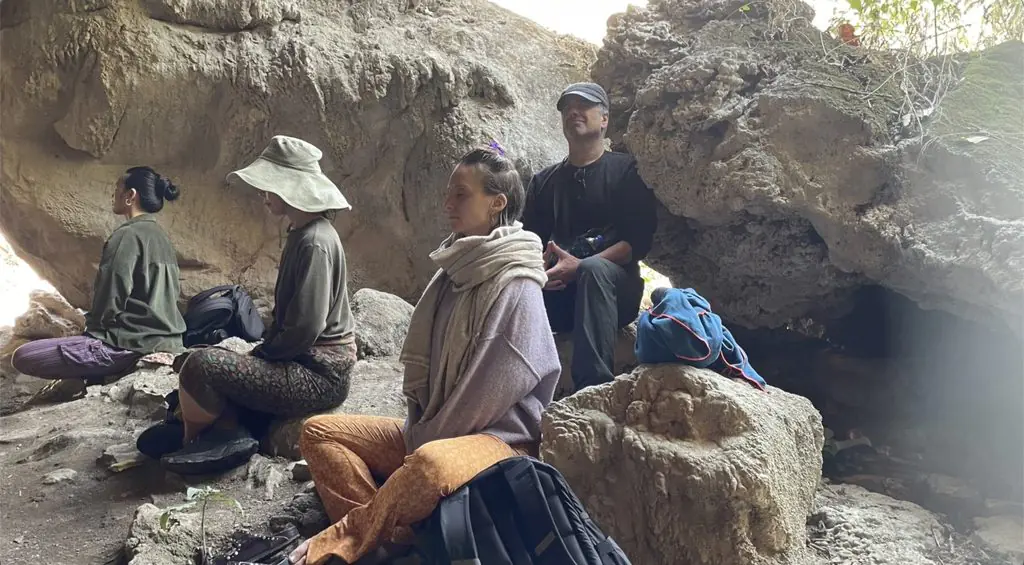
To see how you could study and practise awareness, visit our website (https://vedicyogacentre.org) and select the program that best suits your needs. Every course is based on the concept of awareness.
Watch our YouTube video, Experiencing your essential nature: A spiritual guide to inner awareness and surrender.
You may also enjoy our blog entitled Yoga & Ayurveda in modern life – wisdom from the Himalayan tradition