Pranayama & the nervous system: A Vedic yoga perspective
(based on the ancient teachings of the Himalayan tradition)
Modern texts often translate pranayama simply as breath control. However, this definition does not express its full meaning, or the connection between pranayama and the nervous system.
In the Vedic yoga tradition, pranayama is the regulation and expansion of prana, the vital force that sustains the body. Breath is the vehicle through which the prana is transported.
Modern science associates respiration with the autonomic nervous system, i.e., the body’s inner activity taking place without conscious direction, such as the heart rate, digestion and states of nervous arousal. However, through yogic practices, we can consciously change the depth, rhythm and duration of the breath. In the same way, pranayama helps influence the body, steady the nervous system, discipline the mind and increase awareness of subtler dimensions of your life.
The breath as a bridge between body and mind
Most functions of the autonomic nervous system are not ordinarily controlled by conscious choice. The heart beats, the digestive organs secrete fluids, and the internal organs adjust themselves without command.
Breathing is different.
Although respiration continues automatically, it is possible to regulate it voluntarily. We may breathe more slowly, deepen the inhalation, lengthen the exhalation or pause between breaths. This makes breathing a possible entry point for inner discipline.
A disturbed mind leads to uneven breathing. When the breath is shallow, fear may be present. Anger can make it forceful. Anxiety may cause it to become rapid and unsteady. Similarly, deliberately calming the breath encourages the mind and body to become calmer and more peaceful.
The ancient sages observed this intimate relationship long before modern instruments could measure respiratory rhythm, heart rate or nervous-system activity. Their conclusion was practical: regulate the breath, and the mind becomes easier to manage.
Pranayama and the nervous system
The autonomic nervous system helps regulate the body’s internal functions. It has two major divisions: the sympathetic and parasympathetic systems, which work together to maintain balance according to the needs of the moment:
- The sympathetic system relates to activity, alertness and mobilisation.
- The parasympathetic system supports rest, digestion, restoration and conservation of energy.
Traditional pranayama practices help the practitioner become more conscious of this fluctuating internal state. Slow, smooth and unforced breathing supports relaxation. By contrast, dynamic practices temporarily increase alertness and the movement of energy throughout the body.
Many students try to force the development of pranayama. This becomes an act of violence; in other words, you should never force the breath to dominate the nervous system. It is a process of patient practice and awareness. First, the practitioner must make the breath calm, smooth and comfortable. Only then can the teacher introduce the deeper practices, including breath retention,
If pranayama is part of your practice, you should seek the guidance of an appropriately experienced teacher.
The role of the vagus nerve
The vagus nerve forms part of the parasympathetic nervous system. It travels from the brain through the neck and into the chest and abdomen, communicating with organs such as the heart, lungs and digestive system.
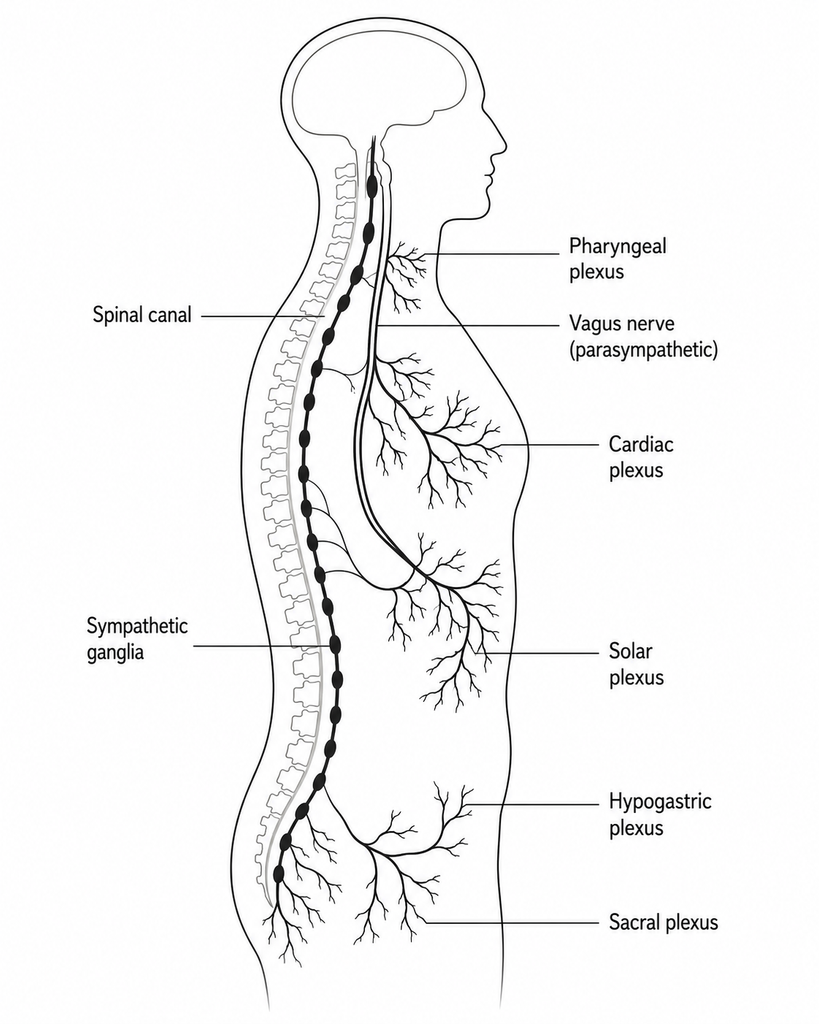
Breathing is often discussed in relation to the vagus nerve’s activity because it affects the movement of the diaphragm, the rhythm of the heart, and the balance between stimulation and relaxation. But from a traditional yogic point of view, the principle is simple: movement of the breath influences the practitioner’s internal state.
When the breath is short and uneven, the mind is usually scattered. When the breath becomes quiet and refined, the mind becomes more stable and inwardly directed. But you should never confuse modern anatomical language with traditional yogic expressions. The vagus nerve is a physical structure, while prana and the nadis belong to the subtle framework yoga describes as the astral body.
While there is some correlation between the two, they should not be seen as identical systems.
Prana is more than oxygen
Modern discussions about breathing often focus on the exchange between oxygen intake and release of carbon dioxide. These are essential physical processes, but the yogic understanding of breath goes beyond this exchange.
Prana is not simply oxygen.
Oxygen is a measurable substance used by the physical body. On the other hand, prana is the subtle life force through which the body, senses and mind are sustained and co-ordinated.
While the breath is one of the main carriers and expressions of prana, prana is not limited to the air entering the lungs. This distinction is important. Pranayama is not simply an exercise for increasing oxygen. Rather, its deeper purpose is to cleanse, balance and raise the prana, your vital energy, in order to develop inner awareness.
Through systematic practice, the practitioner gradually turns the ordinary outward movement of attention within. Energy that, in the past, was dispersed through restless thinking, sensory activity and emotional reaction, now begins to turn back to its Source.
Breath, thought and prana
In traditional yoga, the breath is seen as a fine thread. By learning to grasp this thread, your awareness to the body’s sensations becomes refined, which leads to the purification of the nervous system. Through that awareness, you begin to recognise the chain of thoughts and their power. But to access the deeper current of prana, you have to go beyond the thoughts, which is a consequence of the equanimity of mind created by the pranayama practices.
Therefore, the breath is not the final destination: it is the doorway to subtle awareness.
At first, the practitioner observes the gross breath. Then, awareness gradually becomes more refined, and subtle pauses, inner movements, and mental reactions become visible.
This is why you must practise pranayama with mindfulness. Mechanical breathing may have some physical effect, but traditional pranayama requires conscious participation. Without awareness, it remains incomplete.
The subtle network of nadis
Yoga explains the movement of energy throughout the body as a vast network of subtle channels known as nadis. Different scriptures give different numbers, from 72,000 to 350,000. But you should not interpret these figures as simple physical measurements. Their purpose is to convey the extraordinary subtlety and complexity of the pranic system.
Among the many nadis, the three most significant are:
- Ida – traditionally associated with the left side, lunar qualities, receptivity, cooling and mental activity.
- Pingala – associated with the right side, solar qualities, dynamism, warmth and active energy – your physicality.
- Sushumna – the central channel, regarded as the major pathway of meditation and spiritual awakening.
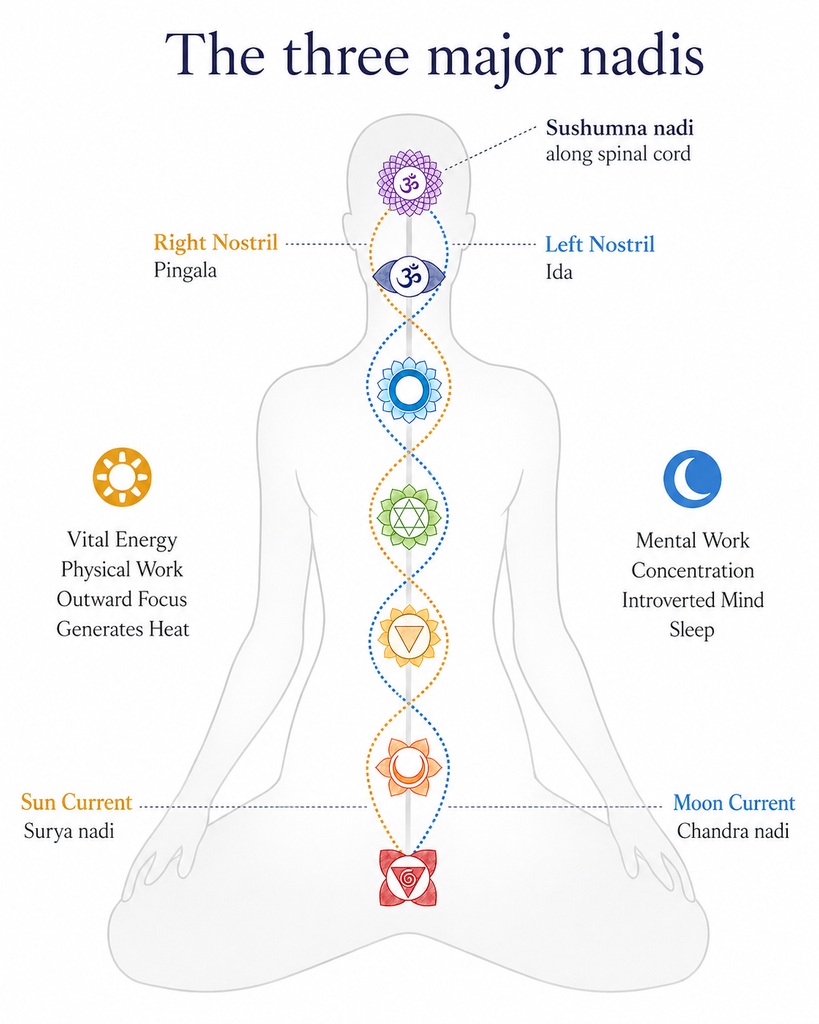
Yogic tradition holds that in everyday life, pranic activity alternates mainly through ida and pingala. In other words, the mind moves between opposing tendencies: activity and rest, attraction and repulsion, pleasure and discomfort, expansion and contraction.
When these forces become balanced, sushumna is activated spontaneously.
Ida, pingala and rhythmic nostril activity
Traditional yoga observes that the flow of breath is often stronger through one nostril than the other.
Pingala refers to the activity of the right nostril, while ida is associated with the left. Practices such as nadi shodhana (alternate-nostril breathing) help purify and harmonise these currents, but there are no practices for the sushumna nadi; its activation is a consequence of the practitioner’s intensity of awareness on the subtle inner activity.
The aim is not simply to open the nostrils physically. Rather, the deeper purpose is to reduce internal noise, harmonise mental and vital energy, and prepare the mind for concentration.
When you balance the ida and pingala, you become less affected by outer disturbances and inner reactions. Meditation can then deepen more naturally.
Sushumna and the path of meditation
The ancient scriptures describe Sushumna as the central channel extending upward through the spine.
In traditional yoga, the awakening of sushumna is essential for higher meditation. As long as prana remains split between the opposing currents, the mind continues to be drawn into duality and distraction. When prana enters sushumna, you become more receptive to the non-physical dimension of life.
This is not a dramatic event that you can force through your desire. Genuine inner opening depends upon preparation, purification, discipline and, ultimately, divine grace. Therefore, the traditional path includes ethical living, balanced food, routine, asana, pranayama, mantra, yoga nidra (relaxation), concentration, devotion and meditation.
Pranayama is powerful, but it does not stand alone.
Chakras as centres of organised energy
The principal points where the major nadis meet are known as chakras. The word chakra means wheel.
Just as spokes extend outward from the hub of a wheel, the nadis are said to radiate from these central points and distribute pranic energy throughout the subtle body. Located along the spine, the seven major chakras are listed in the diagram below, starting from the base of the spine (Muladhara) and rising to the crown of the head (Sahasrara):
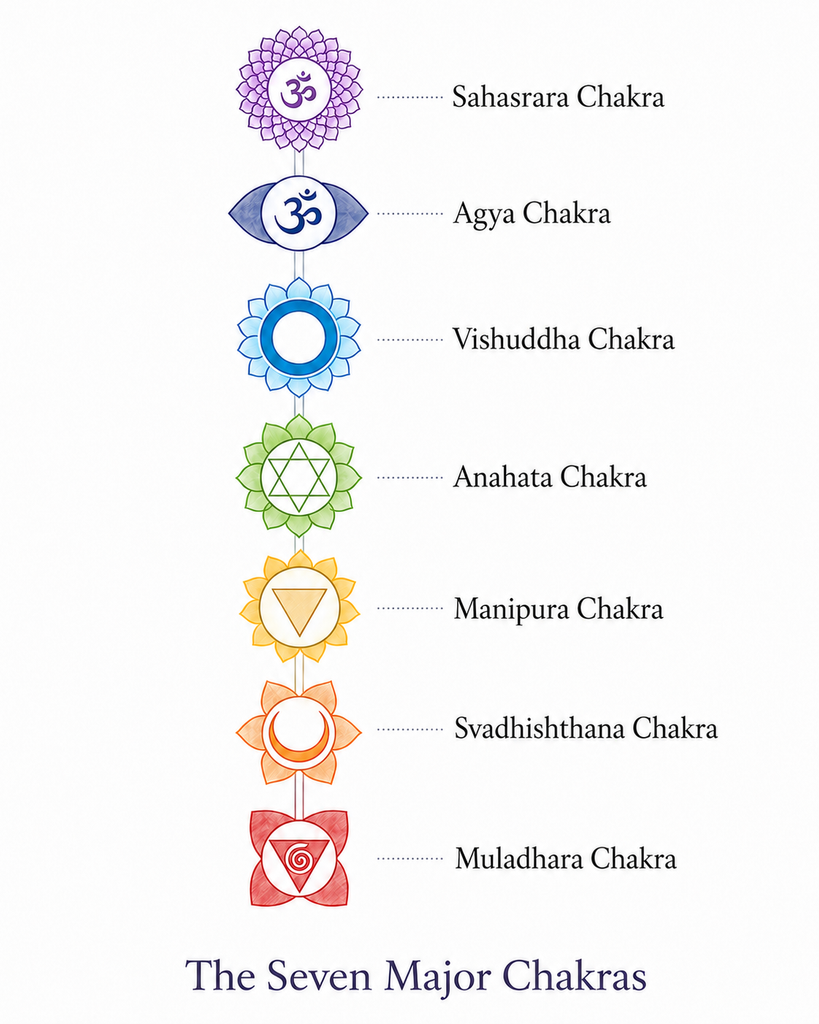
Traditional yoga associates these centres with different levels of instinct, emotion, expression, awareness and spiritual development. The purpose of all the hatha yoga and Kundalini kriya practices is to balance the prana between the ida and pingala and raise it through sushumna towards the crown of the head, where it can connect with the cosmic prana.
In modern times, some people attempt to match each chakra directly with a physical nerve plexus or endocrine gland. Such comparisons are not helpful when studying and practising yoga. The nervous system belongs to the physical body, while the nadis and chakras belong to the subtle body described by yoga.
Kundalini – dormant spiritual energy
Yoga explains Kundalini as the dormant potential energy of each individual. The scriptures represent this symbolically as a sleeping serpent, coiled three and a half times at the base of the spine.
The image of sleep indicates that most human potential remains hidden. In ordinary life, only a small portion of our total energy is consciously available. Much of it remains bound in habit, instinct, unconscious impressions and limited identity. These are the lower human natures.
The purpose of yoga is not to seek mystic experiences but to purify the individual’s instrument so that awareness can expand beyond its current limitations. Through disciplined and mindful practice, practitioners gradually balance the prana, activate the sushumna, and allow the Kundalini to rise through the central pathway.
This upward movement of energy symbolises the transformation of consciousness through the chakras until it reaches the Sahasrara, at the crown of the head.
The union of Shiva and Shakti
In the language of tantra and yoga, Kundalini is Shakti, the dynamic spiritual power. Shiva represents pure consciousness. Yoga aims to unite these two forces within the individual.
Their union at Sahasrara expresses the end of separation between individual awareness and universal consciousness. This is not simply an intellectual concept. It points towards direct spiritual realisation. The individual no longer experiences life only through the narrow boundaries of ego, memory and personal desire. Awareness recognises its deeper identity with the universal Source of life. Traditional yoga describes this as liberation from bondage.
It is not in your power to manufacture such liberation by forceful breathing or intense imagination. It arises through sustained purification, surrender, discrimination and meditation.
Willpower and one-pointed awareness
The old teachings also place great importance on determination, or willpower.
When your mind is scattered, your energy becomes dissipated. As attention moves constantly from one desire, fear or distraction to another, the power of the will becomes weak.
When you train the mind to become one-pointed, your willpower becomes strong. This does not mean harsh self-control. Determination is not about creating tension, but rather it is your capacity to remain steady in a chosen direction without being repeatedly dragged away by old habits.
Pranayama supports this discipline because you learn to stay with the breath. As a result, each inhalation, exhalation and pause becomes an opportunity to cultivate steadiness.
Over time, your impulses no longer completely rule your mind. When a space appears between a stimulus and your reaction to it, it becomes possible to make a conscious choice.
Pranayama and the nervous system at Vedic Yoga Centre
At the Vedic Yoga Centre, we teach that conscious breathing connects the body, nervous system, mind and prana. With regular practice, students learn to steady the breath, calm the mind and become more aware of their physical and emotional responses.
Pranayama is an integral part of every offering at the Centre, but its intensity varies between courses – some focus on simple breath awareness and basic techniques, while others explore pranayama in greater depth.
Kundalini kriya courses and classes, in particular, place a strong emphasis on pranayama because the practices combine breath, movement, sound, concentration as well as awareness on different areas of the physical and astral body. These methods also use the breath in specific ways such as deep inhalation, full exhalation, holding the breath in or out, rhythmic breathing and longer exhalation.
While modern science acknowledges that the parasympathetic nervous system influences the vagus nerve, traditional yoga sees pranayama as more than a way to regulate the nervous system: it is designed to help the practitioner manage prana, steady the mind, and prepare for meditation.
At the Vedic Yoga Centre, students first develop comfortable breathing, body awareness and mental steadiness before moving towards deeper Kundalini kriya practices. In this way, pranayama becomes a practical path from breath awareness to deeper meditation and forms an essential part of the teachings at the Vedic Yoga Retreat Centre, Rishikesh. You can find all the details of our Kundalini Kriya and Meditation program here.
Always practice Pranayama safely
You should always approach the practice of Pranayama gradually and as an intense discipline. Beginners should first establish:
- a comfortable sitting posture
- relaxed diaphragmatic breathing
- smooth inhalation and exhalation
- released tension
- regular practice
- mental attention
People with cardiovascular, respiratory, neurological or other significant health conditions should seek appropriate medical advice and an experienced teacher who practises pranayama regularly. Those who are pregnant or recovering from illness or surgery may also require modifications.
The traditional rule is clear: progress should come through steadiness, not aggression.
A simple preparation for practice
- Sit comfortably with the spine naturally upright. Allow the shoulders, face and abdomen to soften.
- Observe the spontaneous breath without immediately trying to change it.
- Notice where you feel the movement. Observe whether the breath is deep or shallow, smooth or irregular, quiet or strained.
- Gradually allow the exhalation to become slightly longer, without forcing it. Let the inhalation arise naturally.
- Continue for several minutes.
This simple practice begins the process of turning attention inward. It teaches the practitioner to observe rather than interfere.
Once the breath becomes calm, a qualified teacher may introduce practices such as nadi shodhana, bhramari and deeper levels of practice when appropriate.
From breath regulation to higher awareness
The purpose of pranayama is not to collect techniques. It is to develop awareness. Once we have regulated the breath, it begins to regulate the wandering mind.
As the mind becomes quieter, the movement of prana becomes more noticeable. As prana becomes balanced, concentration deepens. When concentration becomes steady, meditation can arise.
This is the traditional progression.
The breath is the visible doorway into an invisible process. Through patient practice, you move from the physical movement of respiration towards the subtle movement of energy, and from subtle energy towards the stillness of consciousness itself.
In this way, pranayama becomes a portal to higher awareness.
Learn pranayama with us in the ancient Himalayan tradition
At Vedic Yoga Centre, we teach pranayama as part of a complete yogic path that includes asana, mantra, yoga nidra (relaxation), meditation, philosophy and disciplined daily living.
Students learn how to practise with steadiness, awareness and respect for the traditional purpose of yoga.
Explore our 200-hour Yoga Teacher Training Course and our other yoga retreat programs in Rishikesh. You can also watch this short YouTube video where Shailendra explains the benefits of regular pranayama practice.
Frequently asked questions
How does pranayama affect the nervous system?
Pranayama changes the rhythm, depth and pace of breathing. Slow, steady practices support relaxation, improve awareness of internal states, and help the practitioner manage anxiety in the nervous system. Different techniques produce different effects, so you should learn where they are appropriate.
Is pranayama the same as deep breathing?
No. Deep breathing is a general term. Pranayama is a systematic yogic discipline involving awareness, regulation, rhythm and, in deeper practice, breath retention and intense concentration on the subtle body.
What is the connection between pranayama and the vagus nerve?
The vagus nerve is part of parasympathetic regulation, and communicates with the heart, lungs and digestive organs. Slow breathing leads to physiological processes associated with relaxation. However, you should not reduce pranayama entirely to vagus-nerve stimulation.
Are nadis the same as nerves?
No. Nerves are physical anatomical structures. Yogic science describes nadis as subtle energy channels. Although traditional writers sometimes compare the two, they are not identical.
Which pranayama balances ida and pingala?
Nadi shodhana, or alternate-nostril breathing, is traditionally practised to balance ida and pingala and prepare the mind for meditation.
Can pranayama awaken Kundalini?
Traditional yoga teaches that pranayama is necessary to awaken Kundalini, but for this awakening to take place, the practitioner must develop spiritual discipline, and never force extreme breathing practices. This requires a great degree of patience.