Experience the Himalayan tradition

Vedic astrology course
in Rishikesh

Study Parashara Jyotisha, mantra, puja and Vedic ritual within a daily rhythm of yoga and meditation.

Our Vedic astrology course in Rishikesh offers a gradual introduction to Jyotisha within its traditional spiritual setting. At Vedic Yoga Centre, you will learn to understand a Vedic birth chart, bring its different elements together, study planetary periods and explore the relationship between astrology and spiritual practice.

Learning begins with careful observation. We take time to understand each principle before drawing conclusions, and we remember that every chart belongs to a living person. The purpose of study is to develop understanding and support conscious action in daily life.
Program at a glance

DetailProgram
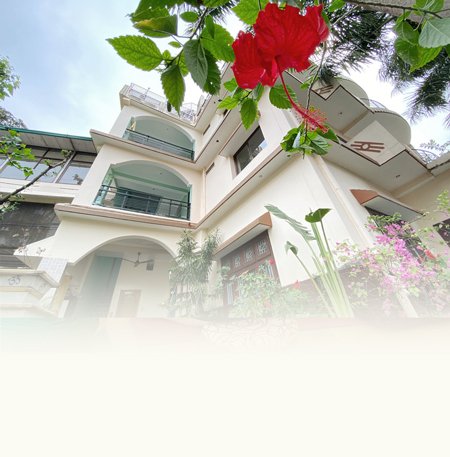
LocationVedic Yoga Centre, Laxman Jhula, Rishikesh, India
StructureFour progressive modules of 10 days each
Complete pathway40 days of study across four modules
Starting levelModule 1 welcomes complete beginners
Study traditionParashara Jyotisha, with mantra, puja and Vedic ritual studies
FeeUS$1,500 per module for one person in a standard room
DatesContact us for upcoming dates and availability

An introduction to Jyotisha

Jyotisha, commonly known as Vedic astrology, is traditionally counted among the six Vedangas, the disciplines supporting the study and application of the Vedas. Its early concerns included understanding time, natural cycles and the timing of sacred observances. It is often described as the eye of the Veda.

This program follows the Parashara tradition, named for Maharishi Parashara, a central teacher in classical horoscope study. Students are introduced to the teachings traditionally attributed to him in the Brihat Parashara Hora Shastra and learn how foundational principles are applied to individual charts.

A horoscope is approached as a way of exploring patterns and tendencies, alongside karma, dharma and personal responsibility. Our emphasis is on considered interpretation, sincere practice and continued learning.

Program inclusions

Four modules with a clear learning pathway

ModuleFocusDuration
1 — FoundationsLearn the language and structure of the birth chart10 days
2 — InterpretationBring the different parts of a horoscope together10 days
3 — TimingStudy planetary periods, transits and life transitions10 days
4 — Mantra and ritualExplore upaya, sacred recitation, puja and supervised ritual10 days

You do not need to complete all four modules in one visit. Begin with Module 1 and continue as your understanding develops. If you have studied Jyotisha before, tell us about your experience so we can discuss the appropriate starting point.

Who is this program for

The program welcomes students who wish to learn Vedic astrology in India while participating in a traditional environment of yoga, meditation and daily spiritual practice. It is suitable for sincere beginners, yoga practitioners and students continuing their study of Jyotisha.

No previous knowledge of astrology or Sanskrit is required for Module 1. Later modules build on the earlier material. A willingness to study carefully, ask questions and practise regularly is more valuable than arriving with memorised predictions.

A birth chart study for chart interpretation
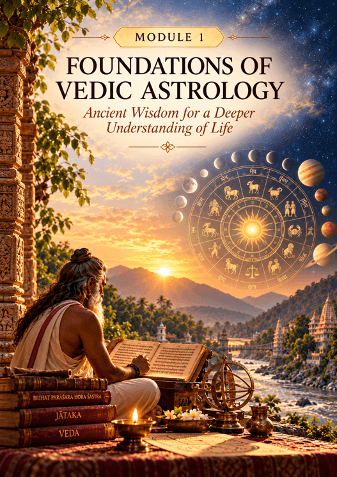
Module 1 Foundations of Parashara Vedic astrology

10 days | Beginner | US$1,500 for one person in a standard room

Begin with the origins of Jyotisha and the basic language of a Vedic horoscope. You will learn to recognise the grahas, rashis, bhavas and Lagna, then gradually bring them together in a simple chart reading.

Curriculum

  • Origins and purpose of Jyotisha, its place among the Vedangas and the Parashara tradition.
  • Preparing a birth chart: birth details, the sidereal zodiac, chart layouts and Lagna.
  • The nine grahas: Sun, Moon, Mars, Mercury, Jupiter, Venus, Saturn, Rahu and Ketu.
  • The twelve rashis: sign order, rulers, elements and qualities.
  • The twelve bhavas: areas of life, house rulership and the Lagna lord.
  • Planetary dignity: own signs, exaltation, debilitation, friendship and enmity.
  • Drishti and planetary conditions: aspects, conjunction, combustion and retrogression.
  • The 27 nakshatras: sequence, rulers, symbolism and the Moon’s position.
  • Yogini dasha: an introduction to its sequence, starting period and birth balance.
  • A first systematic interpretation through guided chart work and review.

What you will develop

By the end of the module, you should be able to describe the basic structure of a Vedic birth chart and support a simple interpretation with several clear observations. This provides the foundation for further study.

Enquire about Module 1

A sage studying Jyotisha beside the Ganges with a celestial wheel
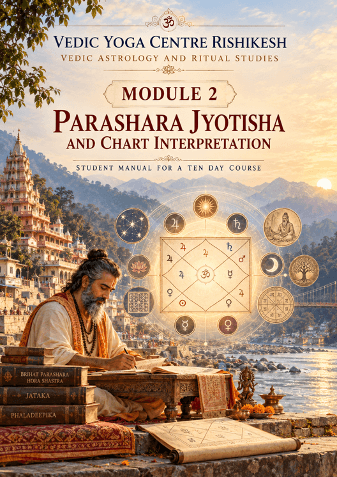
Module 2 Parashara Jyotisha and chart interpretation

10 days | Builds on Module 1 | US$1,500 for one person in a standard room

Once the separate parts of a chart become familiar, the next step is to understand their relationships. This module develops a method for Vedic birth chart interpretation, helping you recognise recurring themes and explain how you reached a conclusion.

Curriculum

  • Whole-chart methodology: move from separate meanings to an organised interpretation.
  • House lords and dispositors: trace connections between different areas of life.
  • Planetary condition: assess dignity, strength and functional roles.
  • Selected Parashara yogas: recognise combinations and examine their qualifications.
  • Deeper nakshatra study: consider rulers, symbolism and individual tendencies.
  • Relationships and family: assess houses, rulers and significators together.
  • Work, livelihood, dharma and wellbeing: explore life direction with balanced judgement.
  • Navamsha or D9: introductory calculation and comparison with the birth chart.
  • Vimshottari dasha: the starting planetary period, birth balance, main periods and sub-periods.
  • Guided chart synthesis: prepare a structured reading and receive feedback.

What you will develop

You should become more confident in bringing the chart together as a whole, rather than relying on one planetary placement. Practical study develops a method that can be explained, reviewed and refined.

Enquire about Module 2

Planetary timing study
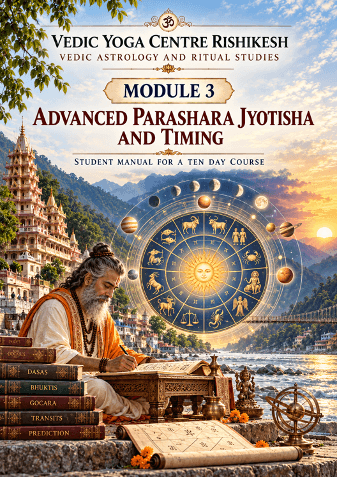
Module 3 Advanced Parashara Jyotisha and timing

10 days | Intermediate study | US$1,500 for one person in a standard room

This module brings chart interpretation together with planetary periods and transits. You will explore when particular themes may become active, while learning to distinguish a considered timing interpretation from an absolute prediction.

Curriculum

  • Establishing the natal foundation: identify the chart factors relevant to a question.
  • Vimshottari dasha calculations: check the sequence, birth balance and calculation settings.
  • Antardasha and Pratyantardasha: understand and calculate sub-periods.
  • Reading the dasha lord: assess rulership, placement, dignity and planetary connections.
  • Gochar: study transits from Lagna and the Moon, particularly Saturn and Jupiter.
  • Rahu, Ketu and nakshatra timing: examine the nodes and lunar framework.
  • Combining natal indications, dasha and transit in a coherent timing interpretation.
  • Appropriate use of Navamsha and selected divisional charts, with attention to birth-time reliability.
  • Life transitions, karma and free will: work, relationships, responsibility and spiritual development.
  • A consultation under guidance: present a case study and communicate uncertainty clearly.

What you will develop

You should develop an intermediate understanding of planetary timing and a more organised approach to consultation. Competent practice continues to develop through study, experience and guidance beyond the module.

Enquire about Module 3

Mantra study and a sacred fire
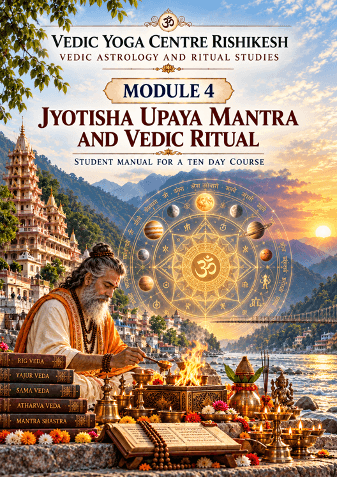
Module 4 Jyotisha upaya mantra and Vedic ritual

10 days | Traditional practice and supervised participation | US$1,500 for one person in a standard room

Jyotisha belongs to a wider spiritual tradition. This module explores how chart understanding may be accompanied by prayer, mantra, charity, seva, meditation and sacred ceremony. Students learn the meaning of selected practices and the awareness with which they are performed.

Curriculum

  • Understanding upaya: supportive spiritual practice and personal responsibility.
  • Mantra japa: listening, pronunciation, repetition and concentration.
  • Textual sources: selected Yajurveda study, paath and stotra, with attention to recitation forms.
  • Graha mantras and prayers: selected traditional practices associated with the nine grahas.
  • The meaning and preparation of puja: personal preparation, sacred space and offerings.
  • Sankalpa: intention and the progression of worship.
  • Navagraha puja and graha shanti: context, prayer and supervised participation.
  • Navarna mantra and timing of practice: traditional context, lunar phases and panchanga study under guidance.
  • Havan, homa, yajna and introductory Karmakanda: observe and study a supervised fire ceremony.
  • Ceremonies, integration and continued practice: review and demonstrate appropriate elements.

What you will develop

You should understand the traditional relationship between Jyotisha, upaya, mantra and ritual, with introductory practical experience. Ten days does not qualify a student as a purohit or priest. Full Karmakanda and Paurohitya require much longer study and direct guidance.

Enquire about Module 4

Your teacher Pandit Kanta Prasad Gaur

Born and raised in Neelkanth Mahadev in the Himalayan foothills, Pandit Kanta Prasad Gaur comes from a Brahmin family with a strong tradition of Vedic learning. He now lives in Laxman Jhula, Rishikesh. He holds an Acharya qualification and a master’s degree in Sanskrit grammar, Vyakarana. His studies also include Vedic astrology, puja, rituals and traditional teachings.

For more than 15 years, he has consulted with people from around the world as a practising astrologer. He also offers prayers and conducts ceremonies, sharing the place of these practices within spiritual life. He has known Shailendra Singh Negi for more than 25 years and teaches ritual practices at Vedic Yoga Centre.

Residential study with yoga and meditation

Daily practice gives space to absorb what you learn. Morning chanting, Hatha Yoga and meditation prepare you for study. Lectures and practical sessions develop understanding, while rest, self-study and evening satsang allow time for reflection.

Example daily routine

TimeSession
6:30–7:00 amMantra chanting and meditation
7:00–9:00 amHatha Yoga and meditation
9:30 amBreakfast
10:30 am–1:00 pmJyotisha lecture and practical study
1:30 pmLunch
2:00–4:00 pmRest and self-study
4:00–5:20 pmGuided study, discussion or practical work
5:20–5:35 pmBreak
5:35–6:30 pmRelaxation, kriya, Yoga Nidra and meditation
6:30–7:30 pmSwadhyaya, japa and silent reflection
7:30–8:00 pmDinner
8:00–9:00 pmKirtan, satsang, chanting and silent meditation

The timetable is indicative and may be adjusted for the module, practical sessions and the needs of the students.

Course fees and enquiries

Each 10-day module costs US$1,500 for one person staying in a standard room. Please contact us for course dates, availability and details of other accommodation options.

Module

Standard room for one person

Module 1

US$1,500

Module 2

US$1,500

Module 3

US$1,500

Module 4

US$1,500

The Vedic astrology study pathway at Vedic Yoga Centre in Rishikesh, India, progresses consecutively from Module 1 through to Module 4. Each module builds on the knowledge developed in the previous one. Students with previous experience who wish to bypass a module must provide evidence of earlier study covering that module’s content.

Students wishing to complete all four modules in one visit can do so through special arrangements made with the Centre in advance.

A certificate from Vedic Yoga Centre will be provided upon successful completion of each module.  Students must attend all classes and sessions to be awarded a Certificate.

Enquire about the astrology program

Frequently asked questions

Can I join as a beginner?

Yes. Module 1 begins with the foundations and requires no previous knowledge of Vedic astrology or Sanskrit.

Do I need to complete all four modules together?

No. You can progress across separate visits. Each module builds on the previous material.

Can I enter a later module?

If you have previous Jyotisha experience, contact us with details of your study so we can discuss the appropriate module.

How long is each module?

Each module runs for 10 days. The four-module pathway comprises 40 days of study.

What is the cost?

The fee is US$1,500 per module for one person staying in a standard room. Contact us about other accommodation options.

Will I practise chart interpretation and rituals?

The astrology modules include guided chart work. Module 4 includes demonstrations and supervised participation in selected traditional practices.

Does Module 4 qualify me as a priest?

No. It is an introduction to ritual study. Traditional priestly training requires much longer study and direct guidance.

How do I find course dates?

Send an enquiry with your preferred module and travel dates, and we will advise you about the upcoming schedule.